#Добро пожаловать в он может Ко., ООО

баннер
  • What Is the Difference Between PLC and DCS Controllers? A Complete Guide
    What Is the Difference Between PLC and DCS Controllers? A Complete Guide Jul 24, 2026
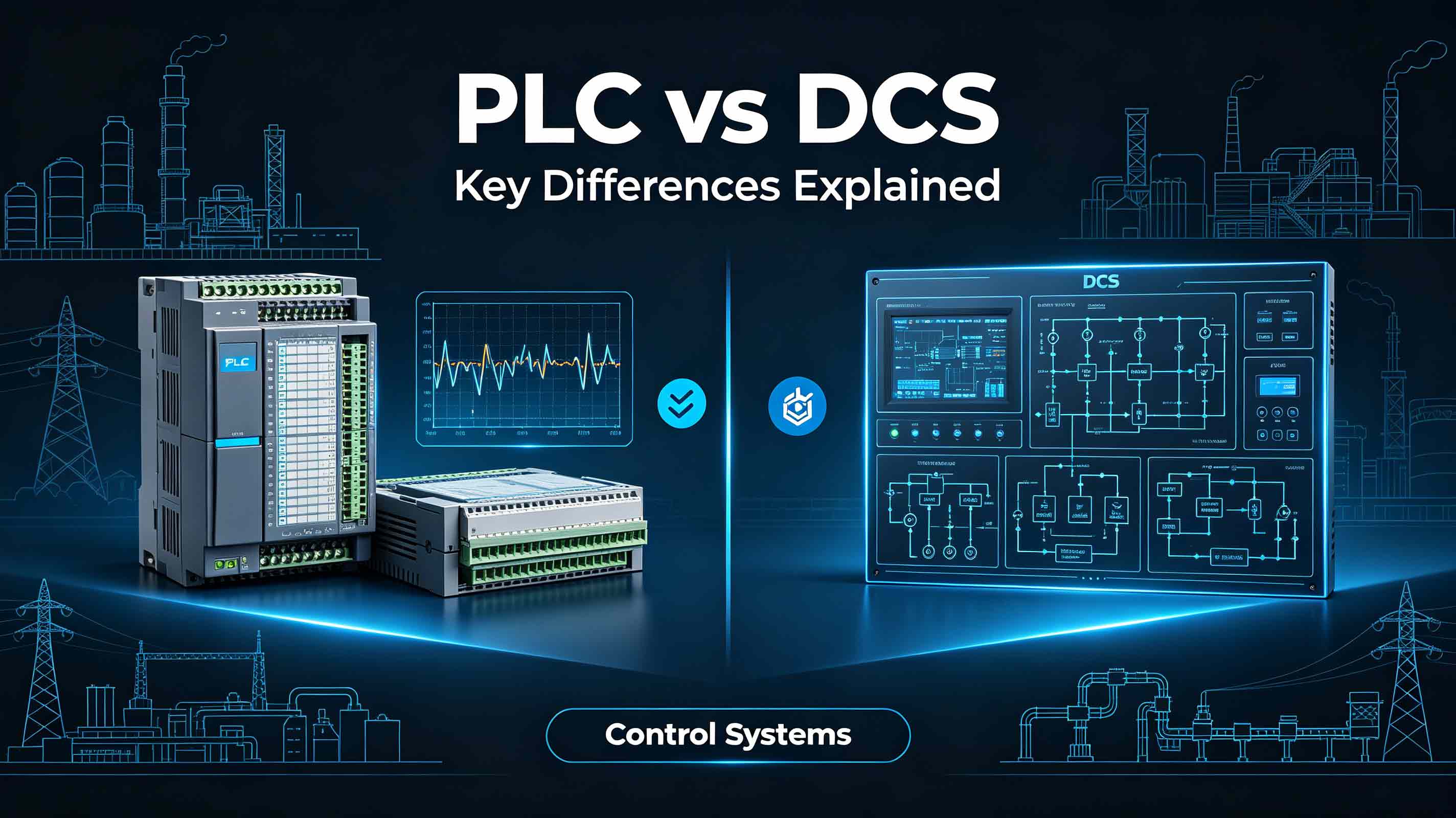
      In industrial automation, PLC and DCS are the two most widely used control systems. Both can monitor equipment, execute control logic, and keep production running stably. However, most engineers and procurement personnel often struggle to tell them apart: when should you choose a PLC, and when is a DCS more suitable? Although modern PLC and DCS functions overlap increasingly, their core design philosophy, system architecture, and applicable scenarios are fundamentally different. This article will break down their differences in plain language, covering working principles, application scenarios, performance characteristics, and cost, to help you make accurate project selections. 1. Core Definition & Original Design Purpose The essential gap between PLC and DCS stems from their original design positioning, which determines their inherent strengths and weaknesses. PLC (Programmable Logic Controller) PLC was developed in the late 1960s to replace cumbersome, unreliable relay-logic control panels. Its original core positioning is discrete on/off logic control, which handles equipment start/stop, safety interlocks, sequential operation, and high-speed boolean judgment for field switching signals. It is inherently designed for standalone equipment and skid-level control, prioritizing fast scan speeds and reliable discrete signal processing. While modern PLCs integrate high-precision PID analog regulation and complex algorithm functions, their fundamental architectural advantage remains high-speed discrete logic execution and flexible on-site programming, rather than large-scale coordinated process control. DCS (Distributed Control System) DCS (Distributed Control System) is a specialized control system built for large-scale, continuous, and thermally integrated process industries. Its core design principle is strictly industry-standard: distributed decentralized control, centralized unified supervision. It distributes independent control functions to decentralized field control stations, avoiding centralized single-point concentration of control tasks. The upper monitoring layer realizes unified data collection, real-time monitoring, parameter tuning, production scheduling and fault management. DCS is optimized for long-term stable closed-loop control of analog process variables, including temperature, pressure, flow rate, liquid level, and composition parameters in continuous production. 2. Key Structural & Working Principle Differences The architectural differences directly lead to their distinct performance and expansion capabilities. PLC: Centralized Control Architecture Standard PLCs adopt a centralized control architecture: one or multiple CPU main controllers undertake all logic operation, program scanning, and data processing tasks. Field I/O modules are directly mapped to the main controller, featuring simple topology, fast response, and convenient debugging. This architecture is lightweight and highly adaptable for standalone equipment and small-scale system integration. Working feature: PLC executes cyclic program scanning with ultra-short scan cycles (microsecond to millisecond level), enabling instant response to sudden discrete signal changes and fast logic interlock actions. It is critical to clarify that only non-redundant basic PLC systems have single-point failure risks; high-end industrial-grade PLCs support CPU redundancy, power redundancy and network redundancy to avoid full-system shutdown. The centralized structure limits its adaptability for large-scale plant-wide process coordination. DCS: Distributed Hierarchical Architecture DCS adopts a standardized hierarchical distributed architecture, consisting of field I/O layers, independent control station layers, monitoring operation layers, engineering configuration layers and data service layers. Each control station operates independently, autonomously completing closed-loop control and logic judgment of local process units without relying on upper monitoring devices. Working feature: DCS is equipped with full-link redundant design (control station, network, power supply, server) as standard. The failure of a single I/O point or local control station only affects the corresponding small process unit, without causing system-wide outage or data loss. It is optimized for synchronous operation of dozens or even hundreds of closed-loop PID control loops, with built-in professional process control algorithms, complete historical data archiving, trend analysis and production report functions, which are essential for process industry compliance management. 3. Core Capability & Application Scenario Differences The core selection criterion for PLC and DCS corresponds to two mainstream industrial manufacturing modes: discrete manufacturing and continuous process manufacturing. The essential difference lies in production characteristics: intermittent batch production vs. uninterrupted long-cycle production. PLC’s Main Application Scenarios PLC specializes in intermittent production, discrete signal processing and logic-intensive sequential control, with outstanding flexibility for medium and small-scale automated systems and standalone equipment. Typical application scenarios include: Mechanical equipment control: packaging machines, assembly lines, machine tools, lifting equipment Automotive manufacturing, 3C electronic production lines Small and medium-sized water treatment, ventilation, and air conditioning systems Scenarios requiring fast switching response and simple logic interlock PLC’s core advantages include flexible programming, fast debugging, low failure rate, and strong adaptability to on-site equipment modification. These features perfectly match the flexible production and independent control requirements of discrete manufacturing. It is worth noting that PLC can also implement small-scale analog closed-loop control, but it lacks native support for large-scale multi-loop coordinated control and standardized process management. DCS’s Main Application Scenarios DCS is professionally optimized for uninterrupted long-cycle production, multi-variable coupling, and complex closed-loop process control, and is the standard configuration for large industrial scenarios that require high operational stability, safety and compliance: Process industries: petroleum, chemical, pharmaceutical, chemical fiber Energy industries: thermal power, hydropower, new energy power stations Large environmental protection, cement, and metallurgical production lines Scenarios requiring full-process monitoring, multi-loop coordinated control, and long-term data tracing DCS natively supports Advanced Process Control (APC), batch sequencing control, production optimal scheduling, and safety instrumented system (SIS) docking. Its standardized data archiving and traceability functions meet the strict production supervision requirements of process industries, which cannot be replaced by conventional PLC systems in large-scale continuous production scenarios. 4. Intuitive Comparison Table: PLC vs DCS Comparison Dimension PLC Controller DCS Controller Core Design Priority to discrete logic, sequence control; supports small-scale PID regulation Priority to continuous process control, multi-variable coupling, large-scale PID loop coordination System Architecture Centralized control, simple and lightweight topology Distributed control + hierarchical management, full-link redundant architecture Response Speed Ultra-fast logic response (μs~ms level), optimized for sudden discrete signal changes Stable and consistent control cycle, prioritizes regulation accuracy for continuous process variables Data Management Basic data recording only, lacks native industrial-level data analysis and traceability functions Complete built-in functions: historical data archiving, real-time trend analysis, automatic report generation, compliant data traceability Scalability Suitable for single equipment, skid-mounted systems and small-scale local expansion Supports plant-wide large-scale networking, cross-unit coordinated control and system-level expansion Cost Low upfront investment, simple maintenance, high cost performance for small and medium-sized projects High upfront construction cost, suitable for long-term stable operation of large process industrial projects Failure Impact Non-redundant PLC has single-point failure risk; redundant PLC eliminates full-system shutdown risk Isolated single-node failure, no system-wide impact, ultra-high operational safety 5. Modern Overlap & How to Choose With the iteration of industrial automation technology, the functional boundary between PLC and DCS has gradually blurred in application. High-end modern PLCs can realize multi-loop analog control and large-scale network expansion, while DCS also supports discrete logic and sequence control. However, their essential architectural design, core positioning and applicable industrial scenarios remain fundamentally different, and the professional selection logic has not changed. Choose PLC if: Control objects are standalone equipment, skid systems or small and medium-sized discrete production lines Control requirements are dominated by switch logic, interlock protection and sequential intermittent operation You pursue low cost, simple debugging, and flexible modification No demand for plant-wide unified data management, compliant traceability and multi-unit coordinated scheduling Choose DCS if: Long-term uninterrupted continuous production with high requirements for production stability and safety A large number of coupled analog process variables require long-term stable closed-loop precise regulation The project requires built-in system redundancy, strong anti-interference ability and industrial safety certification Need plant-wide full-process monitoring, data trend analysis, automatic report output and centralized production scheduling 6. Final Summary To summarize with industry-standard definitions: PLC is a high-flexibility, fast-response controller oriented to discrete equipment and intermittent production; DCS is a high-stability, integrated system oriented to large-scale continuous process industrial production. PLC’s core strengths are speed, flexibility and cost-effectiveness, solving discrete logic and equipment-level control problems efficiently. DCS’s core strengths are operational stability, system integration and standardized process management, meeting the high-standard control and operation management needs of large process factories. Accurate selection based on production modes and control requirements is the key to optimizing project cost and production efficiency. Have you encountered selection confusion in actual projects? Welcome to leave a comment to discuss your PLC/DCS application cases!
  • Allen‑Bradley vs Siemens Industrial Automation Products: PLC, VFD & HMI Complete Guide
    Allen‑Bradley vs Siemens Industrial Automation Products: PLC, VFD & HMI Complete Guide Jul 13, 2026
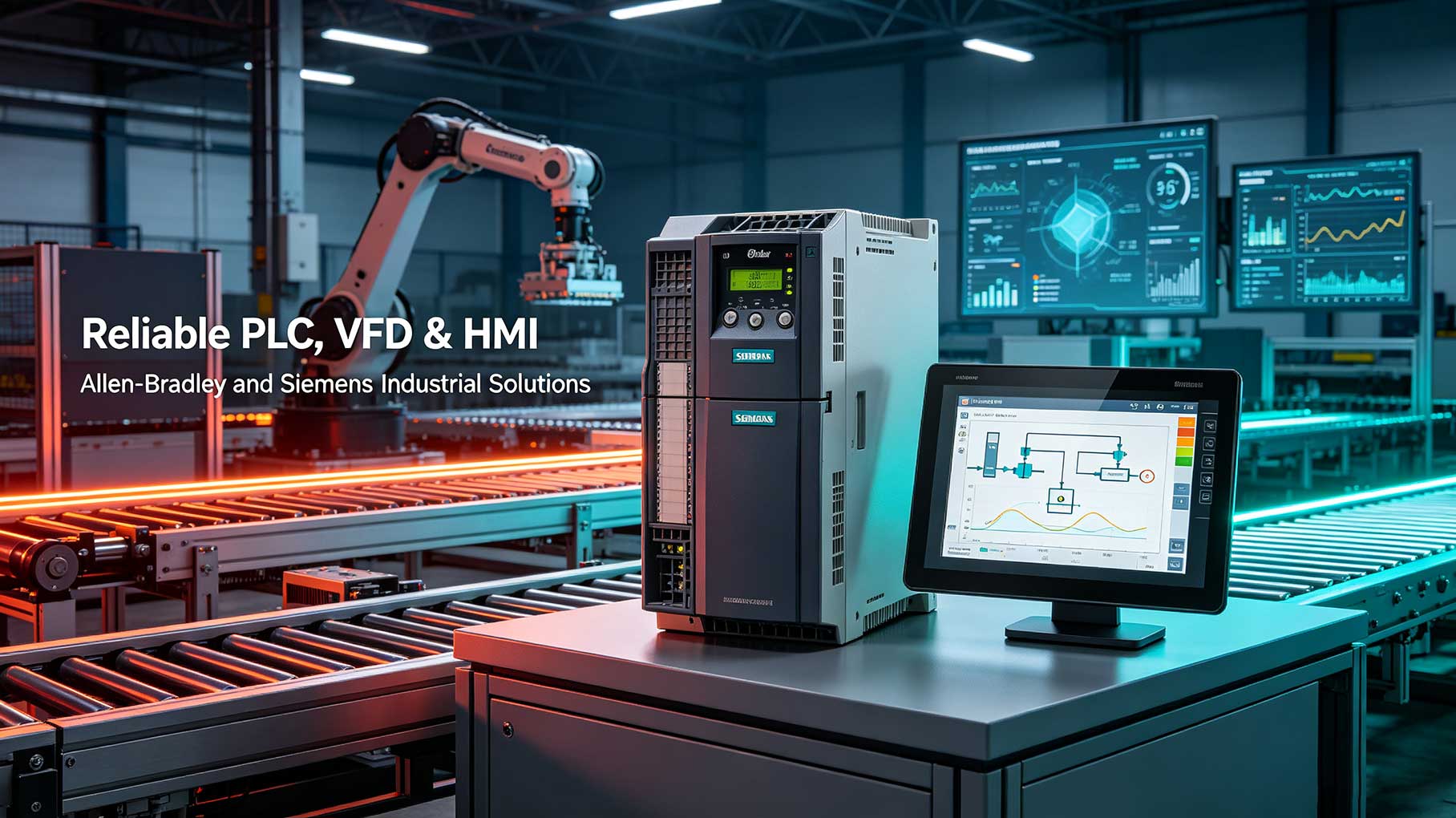
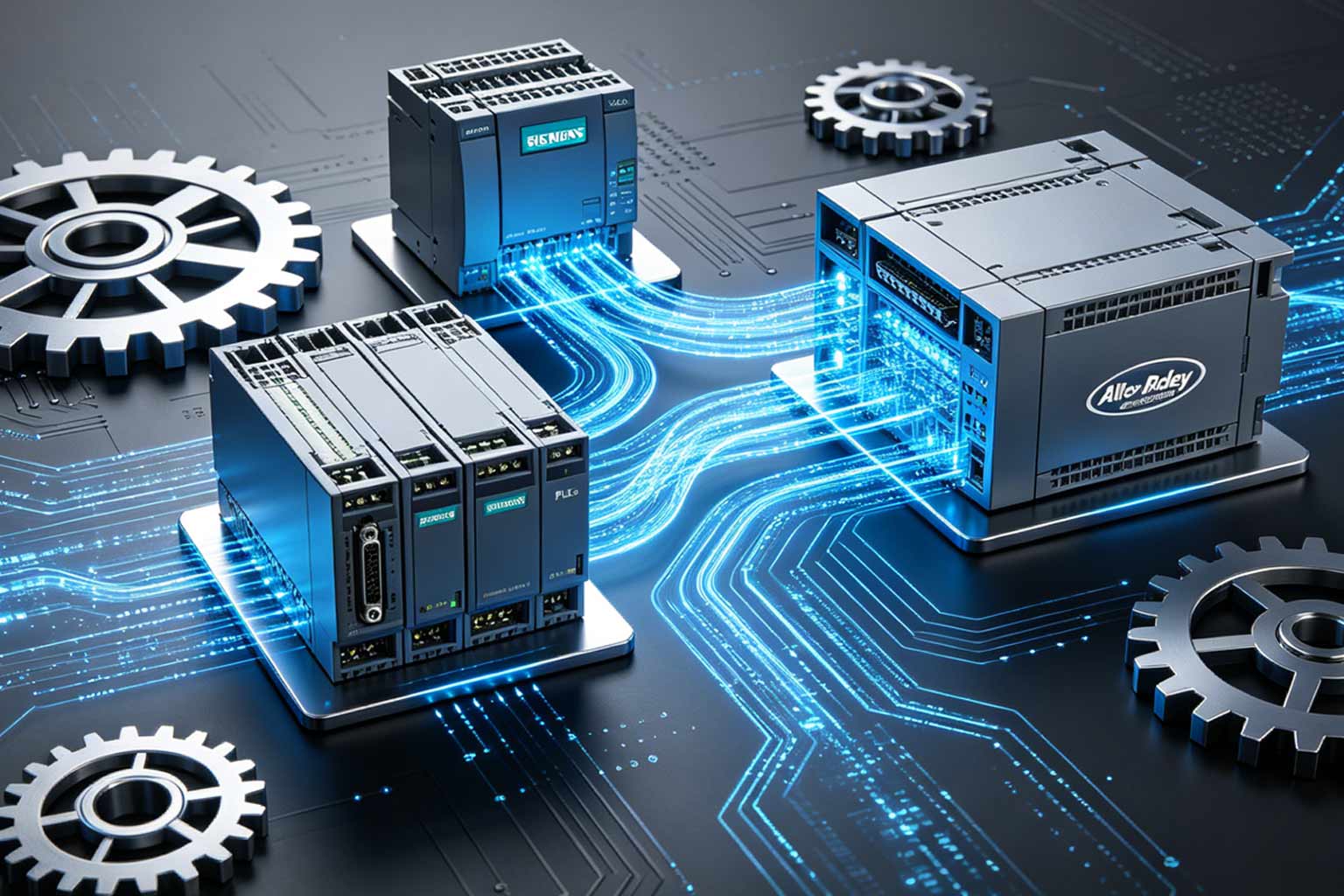
    In modern industrial automation, selecting reliable, high-performance PLCs, variable frequency drives (VFDs), and HMIs (touch screens) is critical to ensuring stable production, efficient operation, and long-term system scalability. As two world-leading automation brands, Allen‑Bradley (Rockwell Automation) and Siemens dominate global industrial control markets, covering discrete manufacturing, process industry, intelligent manufacturing, and factory digital transformation scenarios. Our company provides genuine, full-series Allen‑Bradley and Siemens industrial automation products, including PLC controllers, frequency converters, industrial touch screens, and supporting accessories. In this guide, we break down the core advantages, applicable scenarios, and product features of both brands to help you select the most cost-effective and compatible automation solution for your project. 1. Allen‑Bradley (Rockwell Automation) Core Products & Key Advantages Allen‑Bradley is a benchmark brand in North American industrial automation, famous for itsstable performance, strong compatibility, and user-friendly operation. Its complete product ecosystem realizes seamless integration of control, drive, and human-machine interaction, widely adopted in discrete manufacturing, automotive, packaging, and mechanical equipment industries. 1.1 Allen‑Bradley PLC Allen‑Bradley PLC series covers micro, small, medium, and large-scale models, meeting the control demands of single machines, production lines, and entire factories. Classic product lines include Micro800, CompactLogix, and ControlLogix. Micro800 Series: Compact size, cost-effective, ideal for small automated equipment and simple motion control scenarios, supporting flexible programming and fast debugging. CompactLogix Series: Balances performance and flexibility, suitable for medium-sized production lines, with powerful expandability and stable EtherNet/IP communication. ControlLogix Series: High-end industrial controller, supporting multi-tasking high-speed operation, redundant backup, and complex motion control, perfectly matching large-scale factory automation and high-reliability industrial scenarios. Equipped with Studio 5000 unified programming software, Allen‑Bradley PLCs feature simple programming, convenient later maintenance, and excellent compatibility with Rockwell’s supporting equipment, greatly reducing project debugging and training costs. 1.2 Allen‑Bradley VFD (Frequency Converter) Allen‑Bradley PowerFlex series variable frequency drives are core products for industrial speed regulation and energy saving, including PowerFlex 525, PowerFlex 750 and other mainstream models, covering 0.4kW to hundreds of kW power range. Built-in EtherNet/IP communication and optional PROFINET card, realizing seamless connection with PLC and HMI systems. Integrated standard safety protection functions to avoid equipment damage caused by overload, overvoltage and phase loss. Modular design simplifies on-site installation, wiring and maintenance, supporting USB one-click programming and parameter debugging. Excellent energy-saving performance, effectively reducing equipment operation energy consumption for pumps, fans, and transmission equipment. 1.3 Allen‑Bradley HMI (Touch Screen) Allen‑Bradley PanelView series industrial touch screens support high-definition display, multi-language switching, and real-time data monitoring. They feature anti-interference, dustproof and waterproof industrial-grade design, adapting to harsh factory environments. Paired with Allen‑Bradley PLCs and drives, they achieve one-stop debugging, real-time alarm reminder, and production data visualization management, improving on-site operation efficiency. 2. Siemens Industrial Automation Products & Core Strengths As a global European industrial giant, Siemens automation products are renowned for super system integration, ultra-high stability, and global universal compatibility. Relying on the TIA Portal full-integrated automation platform, its PLC, VFD, and HMI products form a unified and efficient industrial control ecosystem, dominating process industries, chemical, pharmaceutical, new energy, and global OEM equipment markets. 2.1 Siemens PLC Siemens SIMATIC PLC series covers full-range models from micro to high-end, including S7-200 SMART, S7-1200, S7-1500, which are the most widely used industrial controllers in global industrial automation. S7-200 SMART: Cost-effective micro PLC, perfect for small automated equipment, civilian machinery, and small production line control, simple to operate and easy to promote. S7-1200: Mainstream small and medium-sized controller, with powerful motion control, logic control and communication functions, supporting PROFINET industrial Ethernet, suitable for most standard automation projects. S7-1500: High-performance flagship PLC, with ultra-fast response speed, strong expandability, and redundant design, applicable to large process industries, intelligent factories, and high-precision automated production lines. Based on TIA Portal unified programming software, Siemens PLCs realize integrated configuration of PLC, HMI, and frequency converters, with unified data tags and alarm mechanisms, greatly improving project development efficiency and system stability. 2.2 Siemens VFD (Frequency Converter) Siemens SINAMICS series VFDs (V20, V90, G120, etc.) are mainstream industrial speed regulation devices, covering low and medium power ranges, widely used in industrial transmission, speed regulation, and energy-saving transformation scenarios. High operation stability, strong anti-interference ability, adapting to high-temperature, dust and other harsh industrial environments. Support multiple industrial communication protocols, seamlessly connected with Siemens and mainstream brand PLC systems. Built-in multiple energy-saving algorithms and protection functions, extending equipment service life and reducing operating costs. Simple parameter setting and convenient after-sales maintenance, suitable for global large-scale industrial project deployment. 2.3 Siemens HMI (Touch Screen) Siemens SIMATIC HMI series touch screens include basic, comfortable and advanced models, with high-definition touch display, multi-screen linkage, data recording and remote monitoring functions. Cooperated with the TIA Portal platform, it supports one-stop programming and debugging with PLC and drives, realizing visualized management of the entire production process. It is the preferred HMI product for global cross-border factories and standardized automation projects. 3. Allen‑Bradley vs Siemens: How to Choose the Right Automation Solution? There is no absolute difference between good and bad Allen‑Bradley and Siemens products, only the most suitable one for project scenarios. We summarize the core selection suggestions for your reference: Choose Allen‑Bradley: Priority for North American market projects, discrete manufacturing (automotive, packaging, machinery), and factories with existing Rockwell automation systems. It features fast commissioning, simple operation, and low maintenance cost. Choose Siemens: Priority for global cross-border projects, European and Asian market layout, process industries (chemical, food, pharmaceutical, new energy), and projects requiring high system integration and standardized deployment. For most automation projects, adhering to a single brand ecosystem can effectively reduce equipment compatibility risks, engineering debugging time, and later training and maintenance costs. 4. Our Professional Automation Product Supply Service As a professional supplier of Allen‑Bradley and Siemens industrial automation products, we provide 100% genuine original products, complete models, sufficient inventory, and global fast delivery services. Our product range covers all mainstream PLCs, frequency converters, industrial touch screens and supporting accessories of the two brands, meeting the full-cycle procurement needs of automation project design, commissioning, maintenance and upgrade. Our core service advantages: Genuine Original Guarantee: All products are officially sourced, with complete certificates and after-sales warranty, eliminating counterfeit and refurbished risks. Full Model Coverage: Support spot supply and customized procurement of conventional and discontinued models to meet diverse project needs. Professional Technical Support: Provide product selection guidance, technical parameter consultation, and after-sales debugging support. Global Fast Shipping: Efficient logistics system, fast delivery to global regions, shortening project cycle. Cost-Effective Price: Direct factory supply, no middlemen, providing competitive wholesale prices. 5. Final Words Allen‑Bradley and Siemens are the two most reliable choices for industrial PLC, VFD, and HMI automation solutions. Whether you need stable discrete manufacturing control equipment or highly integrated process industrial automation systems, we can provide you with brand-new genuine products and professional one-stop procurement services. If you have product selection, quotation, bulk procurement or technical consultation needs, please contact us now. We will provide you with customized automation product solutions and high-quality service support within the shortest time! Core SEO Keywords Allen‑Bradley PLC, Siemens PLC, Allen‑Bradley VFD, Siemens frequency converter, Allen‑Bradley HMI touch screen, Siemens industrial touch screen, industrial automation PLC VFD HMI supplier
  • Siemens and Allen-Bradley PLC: Trends in Industrial Automation 2026
    Siemens and Allen-Bradley PLC: Trends in Industrial Automation 2026 Jun 19, 2026
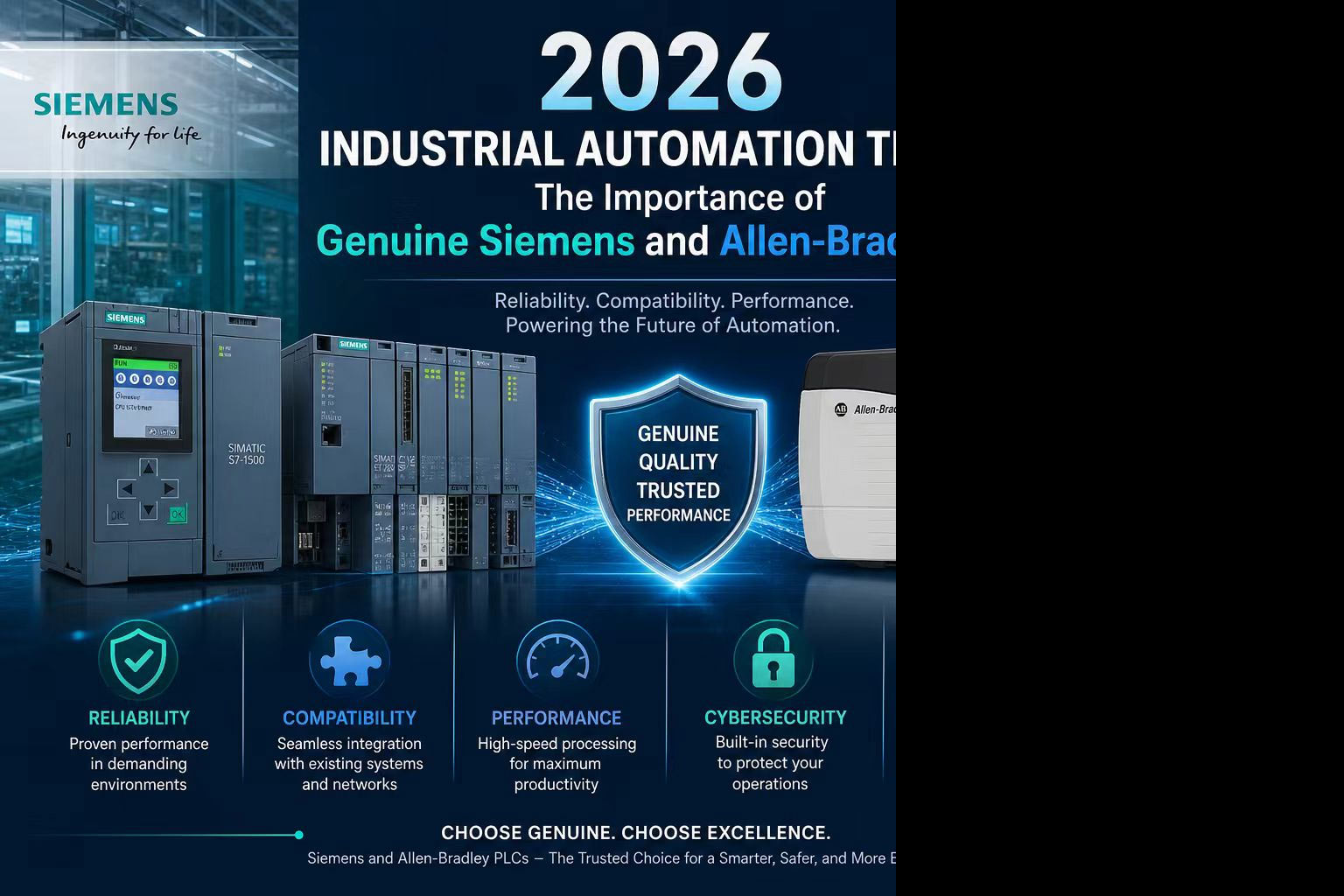
    Published: May 1, 2026   Industry: Industrial Automation & Control Systems   With the continuous acceleration of global smart factory transformation and industrial intelligence upgrading in 2026, production lines across all manufacturing industries are raising higher requirements for operational stability, expandability and intelligent control.   As the core control component of automated production lines, PLC plays a decisive role in the overall operation and management of industrial equipment. More and more factory engineers and system integrators are paying extra attention to the authenticity, stability and long-term compatibility of PLC products when upgrading or maintaining production equipment.   Among industrial control brands, Siemens and Allen-Bradley (AB) have always been recognized as mainstream choices in the industry. With mature technical systems, stable operating performance and complete ecological compatibility, genuine original PLCs can perfectly adapt to various complex industrial scenarios. They support seamless docking with supporting programming software and industrial systems, avoiding operational risks caused by inconsistent parameters or unstable performance.   In the current global supply chain environment, the lead time of many industrial control parts remains unstable. Factories often face downtime risks due to the lack of original PLC spare parts and maintenance modules. Choosing genuine original products with stable supply has become an important guarantee for sustainable production.   We focus on the supply of brand-new and original Siemens and Allen-Bradley PLC products, adhering to strict quality inspection standards to ensure every product is 100% original factory sealed, without refurbished or second-hand parts. We maintain sufficient in-stock inventory of mainstream models, support fast global delivery and complete after-sales warranty and technical guidance, helping global users solve PLC procurement, equipment renewal and daily maintenance demands efficiently.   If you are in need of genuine original PLC inquiry, stock checking or technical consultation, welcome to contact our professional team at any time.
  • Siemens S7-1200 Practical Troubleshooting Guide | Hardware Selection, Programming, Communication & On-site Tips
    Siemens S7-1200 Practical Troubleshooting Guide | Hardware Selection, Programming, Communication & On-site Tips Jun 19, 2026
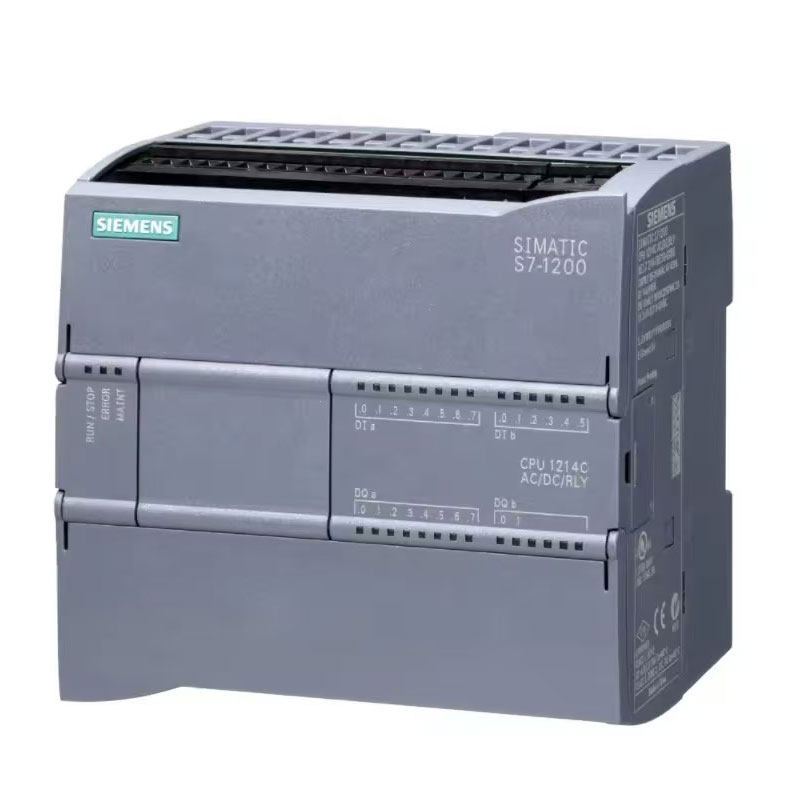
      Introduction Most automation engineers and equipment buyers only master basic programming operations of the Siemens S7-1200 PLC, but frequently encounter various on-site issues: failed PLC connection after equipment arrival, servo jitter, unstable analog data, random fault shutdowns, and program download failures. In most cases, these problems are not caused by hardware damage, but by improper selection, non-standard wiring, incorrect parameter settings, and bad programming habits. This blog focuses entirely on practical, problem-solving skills and high-frequency pitfalls for end users and field engineers. No empty theoretical parameters—all solutions can be applied directly to fix 90% of common S7-1200 faults, stabilize equipment operation, and reduce after-sales costs. 1. Critical Selection Mistakes | Avoid Rework & Financial Loss 1.1 Wrong CPU Power Version = Failed Motion Control Many beginners select PLC models randomly without distinguishing version differences, resulting in unavailable high-speed positioning and servo control after installation. DC/DC/DC Version (Industrial Standard & Preferred) 24V DC power supply, transistor output Supports 100kHz high-speed pulse output, directly drives servo and stepper motors Ideal for all positioning, cutting, reciprocating motion automation equipment AC/DC/RLY Version (Only for Simple On/Off Control) 220V AC power supply, relay output No high-speed pulse function, cannot realize any positioning control Only applicable to fans, water pumps, lighting, and simple start-stop devices Key Rule: Choose DC/DC/DC unconditionally if your device involves servo, stepper, or positioning functions! 1.2 Insufficient CPU Performance Margin | Stuttering & Pulse Loss Field-verified S7-1200 selection standards for industrial projects: Simple logic & ordinary IO devices: 1212C ≤4-axis servo, packaging & conveying equipment: 1214C (Most Popular Universal Model) Multiple analog signals, PID control & multi-device networking: 1215C High-precision positioning, cutting & multi-axis synchronization: 1217C Practical Tip: Keep program memory usage below 70% and OB1 cycle time within 100ms. Exceeding these values will easily cause packet loss, program stuttering, and random equipment shutdowns. 1.3 Disordered Expansion Module Installation | Module Recognition Failure S7-1200 has strict expansion slot rules. All expansion modules must be installed sequentially from the first slot on the right of the CPU. Empty slots or disordered installation will trigger faults and make modules unrecognizable. Optimal Layout Skill: Keep communication and power modules away from high-temperature modules to avoid high-temperature crash faults; place digital output modules on the rightmost side to reduce signal interference. 2. Hardware Wiring & Installation Tips | Eliminate Interference & False Triggering 2.1 Unstable Analog Data & Signal Drift | Permanent Solution Common on-site fault: Temperature, pressure and flow data jitter continuously, even with intact sensors and correct programs. Solutions: Use shielded cables for analog signals with single-end grounding Separate power cables (servo/inverter cables) from signal cables with a distance of more than 20cm; never lay them in the same pipe Enable analog filtering and smooth sampling in TIA Portal to eliminate data drift completely 2.2 Digital Input False Triggering & Random Light Flashing Many users encounter random flickering of PLC input indicators during equipment shutdown. Cause: Power frequency interference and induced voltage of long signal cables Solution: Adjust DI input delay to 3ms~5ms in TIA Portal hardware configuration to eliminate false triggering thoroughly with low cost. 2.5 Random Restarts & Faults Caused by Unstable Power Supply S7-1200 CPUs are sensitive to power ripple. Low-quality switching power supplies will cause random disconnection, program loss and module errors. Recommendation: Adopt industrial regulated power supplies, and install anti-interference magnetic rings at the CPU power terminal to greatly improve equipment stability. 3. Programming Practical Skills | Stable, Maintainable & Bug-Free Programs 3.1 Avoid Abusing Memory Bits (M Bits) to Prevent Hidden Faults Novice engineers often use M0.0, M0.1 and other M bits for intermediate logic, which leads to variable conflicts and logic disorder after long-term equipment operation. Best Practice: Prioritize DB data blocks for S7-1200 programming. Independently allocate variables for equipment actions, alarms and statuses to ensure clear logic, no conflicts and easy maintenance. 3.2 Timer Pitfall | Avoid Timing Deviation & Logic Drift Common fault: Inaccurate timing and drifting cycle logic during long-term operation. Avoidance Rule: Do not mix TON and TOF timers for cyclic oscillation logic. Uniformly adopt IEC timers for stable resolution and zero cumulative time error. 3.3 Add Fault Tolerance for Analog Programs | Prevent Equipment Crash Sensor disconnection and poor contact will cause program crash, PID out-of-control and misoperation without fault tolerance logic. Universal Fault Tolerance Method: Set upper and lower limit judgment for analog data. Lock outputs and trigger alarms when values exceed the normal range to avoid over-temperature and over-pressure risks. 3.4 Ultimate Solution for Axis Homing Faults High-frequency problem: The axis stops with an alarm when hitting the limit switch during homing, without automatic reverse reset. Solutions: Enable the "limit switch automatic reverse" function in hardware configuration Properly increase acceleration and deceleration time to avoid hard collision with limits Reserve a safe distance between limit switches and mechanical stops 4. Communication Troubleshooting | Fix Connection Failure & Random Disconnection 4.1 PLC Not Found & Failed PC Connection 90% of connection failures are network problems rather than hardware damage: Default PLC IP: 192.168.0.1, easy to conflict with local LAN IP segments Set a static IP address for the PC network adapter (same segment as PLC), disable automatic IP acquisition Turn off PC firewall and antivirus software to prevent communication interception 4.2 Random Disconnection of PROFINET & HMI Core Skill: Use PROFINET instead of Modbus for multi-device networking. Properly extend the communication timeout, and adopt industrial shielded Ethernet cables to eliminate on-site interference disconnection. 4.3 Program Download Failure Caused by Firmware Version Mismatch High-frequency pitfall: Programs compiled with high-version TIA Portal cannot be downloaded to low-version firmware PLCs. Solution: Check the PLC firmware version before downloading, match the hardware version in TIA Portal, or upgrade the firmware online to unify versions. 5. On-Site Fast Troubleshooting Skills | After-Sales Efficiency Tool 5.1 Diagnose via Diagnostic Buffer (Fastest Fault Location) S7-1200 is equipped with a powerful built-in diagnosis system, recording the exact time and cause of all shutdowns and module faults. Enter online mode in TIA Portal and check the diagnostic buffer to locate faults accurately, avoiding blind line and program inspection. 5.2 Random Shutdown Without Alarm Prompt Main causes: Excessive program cycle time, high memory occupancy, and electromagnetic interference. Solutions: Simplify program logic, reduce OB1 cycle time, optimize wiring layout, and add anti-interference measures. 6. Daily Maintenance & Lifespan Extension Tips Regularly clean dust from the PLC heat dissipation channel to avoid high-temperature frequency reduction and crash faults Install a memory card for key projects and back up programs regularly to prevent program loss Check the power supply voltage before powering on long-term shutdown equipment to avoid CPU damage from voltage surge Never hot-swap signal modules to prevent port burnout Summary The Siemens S7-1200 PLC features excellent inherent stability. 90% of on-site faults are caused by wrong selection, non-standard wiring, missing parameter settings and lack of program fault tolerance. Mastering the above practical skills can help you avoid procurement pitfalls, completely solve common problems such as analog jitter, communication disconnection, positioning faults and random shutdowns, greatly reduce after-sales pressure, and improve overall equipment stability. Interaction: What tricky S7-1200 faults have you encountered on-site? Leave a comment to share your troubleshooting experience!
  • Reliable Industrial Automation Components & All-in-One Solutions from Guangzhou Heneng Automation
    Reliable Industrial Automation Components & All-in-One Solutions from Guangzhou Heneng Automation Jun 19, 2026
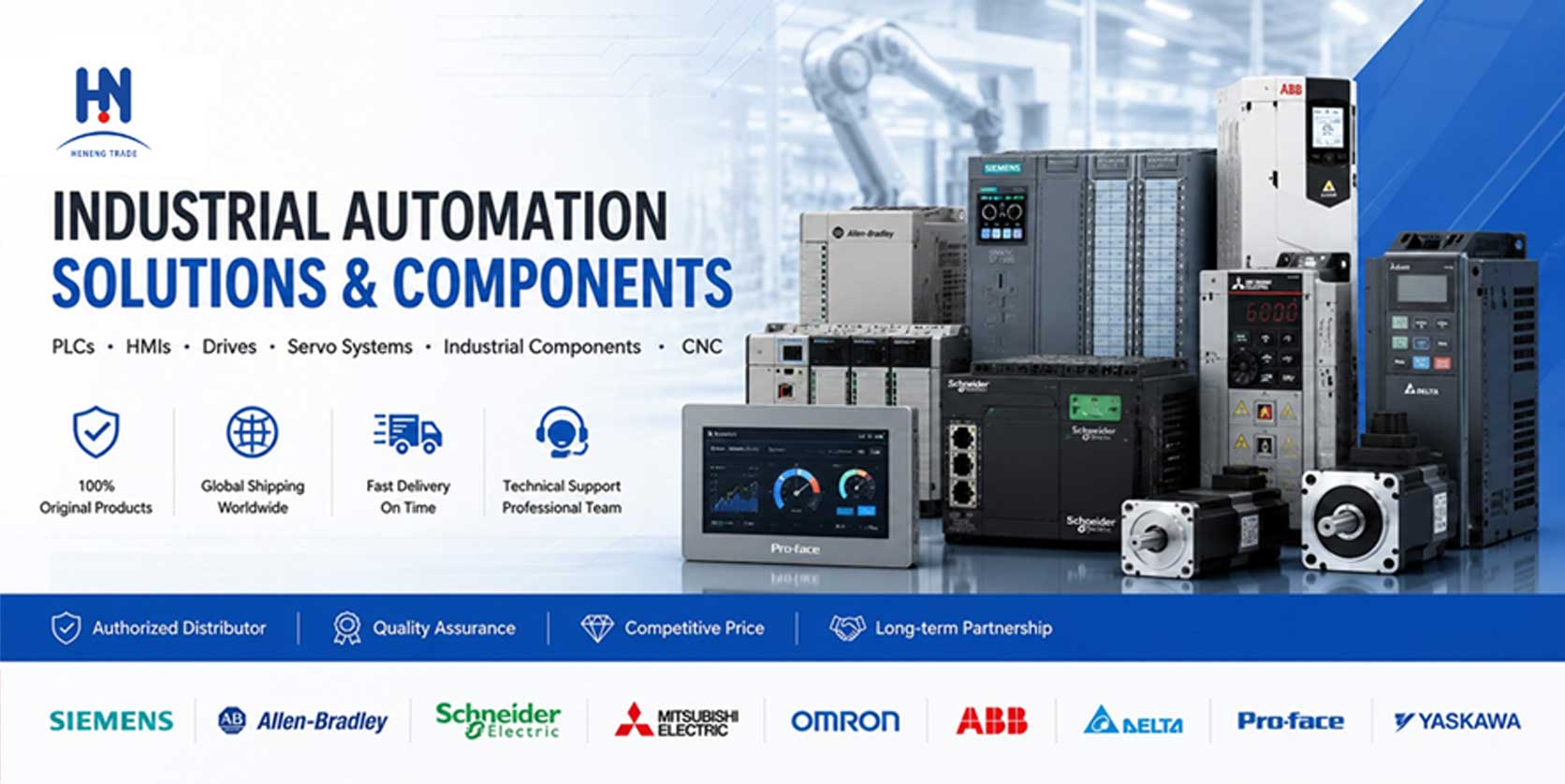
    Introduction   Industrial automation is the core driving force of modern intelligent manufacturing. Stable, genuine, high-performance automation hardware directly determines production line efficiency, uptime and long-term operational costs. At Guangzhou City Heneng Automation Equipment Co., Ltd., we focus on supplying full-series brand industrial automation spare parts and customized automation system solutions for manufacturers, system integrators and engineering companies worldwide.   Our product portfolio covers the full chain of factory automation: PLCs, HMI touch screens, variable frequency drives, servo motors & drives, CNC controllers, sensors and other industrial electrical components. We cooperate with top global automation brands, deliver 100% original authentic products, and provide end-to-end support from product supply to professional technical after-sales service.   Full Range of Authorized Brand Products   As a trusted authorized distributor for mainstream international automation brands, we stock complete series of original parts for every brand shown in our catalog:   Siemens: S7-1200/1500/300/400 PLCs, SIMATIC HMI, G120/G130 series inverters, ET200 remote modules Mitsubishi Electric: FX/Q/L/R series PLC, FR-D740/E800 series drives, MR-JE/J4 servo systems, CNC units Schneider Electric: Modicon PLC, Altivar frequency converters, industrial switches, control relays Allen‑Bradley: CompactLogix, Micro800 PLC, PowerFlex drives, industrial I/O modules ABB: ACS series inverters, soft starters, low-voltage control components Delta: VFD inverters, ASDA servo systems, DVP PLC series Pro-face: Industrial touch screen HMIs for industrial human-machine interaction Omron: CP/CP1E PLC, 3G3MX2 inverters, proximity sensors, safety relays Yaskawa: Sigma servo motors, V1000/A1000 variable frequency drives   All goods are brand-new original, complete with official packaging, certificates and factory warranties. Whether you need single replacement spare parts or bulk stock for project construction, we can meet your procurement demands efficiently.   Our Core Advantages for Global Clients   1. 100% Original Authentic Guarantee   We strictly control our supply chain, every product we ship is sourced from official brand channels. We reject counterfeit, refurbished or disassembled goods, and provide full product certification for customs clearance and factory inspection, eliminating quality risks for your production lines.   2. Global Door-to-Door Shipping & On-Time Fast Delivery   We support worldwide logistics services covering Europe, Southeast Asia, North America, Middle East and other regions. With large in-house inventory stored in our Guangzhou warehouse, most common models can be shipped within 24–48 hours. We optimize packaging for fragile electrical equipment to avoid transit damage, and promise stable on-time delivery schedules for your project timelines.   3. Professional Technical Support Team   Our team consists of automation engineers with years of industry experience. We provide free technical consultation: model selection guidance, parameter debugging guidance, wiring tutorials, fault diagnosis and after-sales troubleshooting support. No matter you are new to automation or a professional system integrator, we can solve your technical problems promptly.   4. Competitive Factory Direct Pricing & Stable Stock   Thanks to long-term cooperative relationships with brand manufacturers, we cut intermediate links to offer cost-effective prices for bulk and small orders. We maintain a large inventory of mainstream hot-selling models, avoiding long lead times caused by brand official stock shortages.   5. Long-Term Win-Win Partnership   We don’t only act as a parts supplier — we aim to build long-term cooperative partnerships with all clients. For system integrators, machinery manufacturers and overseas trading companies, we provide exclusive agent policies, customized quotation plans and dedicated account managers to support your business growth.   6. Strict Quality Assurance System   Every batch of products undergoes pre-shipment testing to verify normal operation before delivery. We provide formal warranty services consistent with official brand standards, so you have reliable after-sales protection after purchase.   What We Can Do For Your Business   Supply replacement spare parts for production line maintenance & equipment overhaul Complete component procurement for new automation machinery & CNC equipment Customized one-stop automation solution matching your production process Bulk wholesale supply for overseas automation distributors & trading firms Technical consulting for equipment upgrading, transformation and program optimization   Conclusion   In the competitive intelligent manufacturing industry, choosing a reliable automation component supplier is critical to your business success. Guangzhou City Heneng Automation Equipment Co., Ltd. sticks to the service tenet of "Genuine Products, Competitive Price, Professional Service". We integrate top global brand automation hardware resources to deliver convenient, safe and cost-effective procurement solutions for global industrial customers.     If you have demands for PLC, HMI, drives, servo or any industrial automation components, feel free to contact our sales team for catalogs, quotations and technical consultation. We look forward to establishing stable long-term cooperation with you! Contact Information   Yunlong   Guangzhou Heneng Trading Co., Ltd.   Guangzhou City Heneng Automation Equipment Co., Ltd.   Electrical | Automation | Components   📧 E-mail: yunlong@henengindustry.com   🌐 Website: https://www.henengindustry.com/   💬 WhatsApp / WeChat: +86 17610175576    
  • Key Differences Between Siemens and Allen-Bradley PLCs: Which to Choose for Your 2026 Automation Project?
    Key Differences Between Siemens and Allen-Bradley PLCs: Which to Choose for Your 2026 Automation Project? May 27, 2026
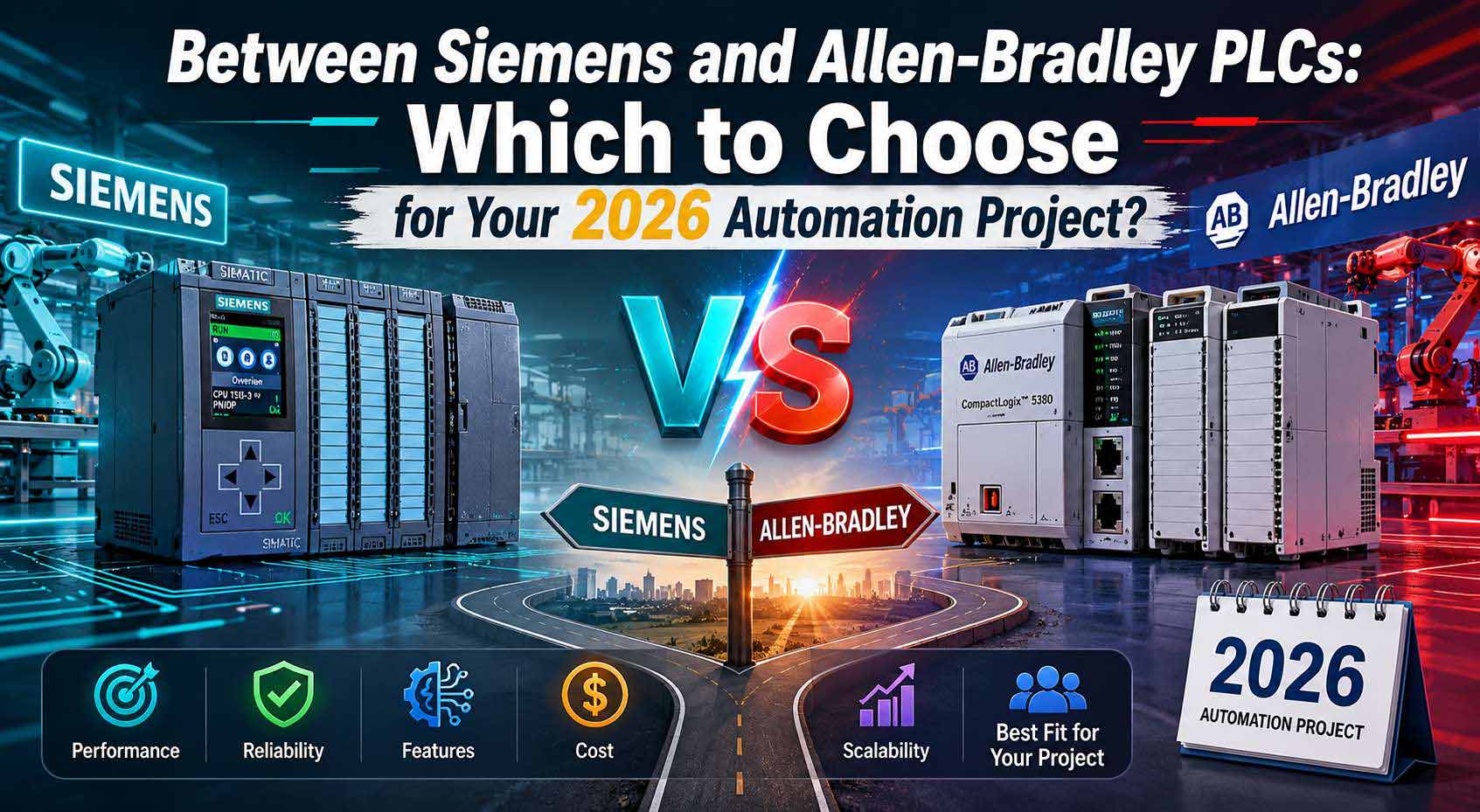
    Introduction   When it comes to industrial automation, Siemens and Allen-Bradley (Rockwell Automation) are two of the most trusted names in PLC technology. Both brands power factories, production lines, and critical processes across the globe—but they differ significantly in design philosophy, ecosystem compatibility, and ideal use cases.   Whether you’re upgrading an existing line or designing a new system, choosing the right PLC can impact long-term maintenance costs, scalability, and operational efficiency. In this post, we break down the core differences between Siemens and Allen-Bradley PLCs to help you make an informed decision for your project.     1. Architecture & Ecosystem   Siemens PLCs   Modular & Distributed Design: Siemens PLCs (S7-1200, S7-1500, S7-300/400) are built for flexibility. They support distributed I/O via PROFINET, making them ideal for large, multi-site operations. TIA Portal Integration: The Totally Integrated Automation (TIA) Portal unifies PLC, HMI, motion control, and safety programming in one software suite, reducing engineering time for complex systems. Open Compatibility: Works seamlessly with third-party devices via standard protocols like PROFINET, Modbus, and OPC UA.   Allen-Bradley PLCs   Rockwell Logix Platform: Allen-Bradley PLCs (CompactLogix, ControlLogix) are deeply integrated with Rockwell’s ecosystem, including Studio 5000 software, FactoryTalk HMI/SCADA, and Allen-Bradley drives/sensors. Native EtherNet/IP: Built for seamless communication with other Rockwell devices, EtherNet/IP simplifies integration for factories already using Rockwell equipment. Focus on North American Markets: The ecosystem is widely adopted in the U.S. and Canada, making it easier to find local support and spare parts in these regions.     2. Programming & Usability   Siemens PLCs   Ladder Logic + Advanced Languages: Supports ladder logic, function block diagram (FBD), structured text (ST), and sequential function chart (SFC), catering to both traditional and modern programmers. TIA Portal Simulation: Built-in simulation tools let you test logic without physical hardware, speeding up commissioning and reducing downtime. Steeper Learning Curve: While powerful, the TIA Portal’s extensive features can take longer to master for new users.   Allen-Bradley PLCs   Studio 5000 Environment: Known for its user-friendly interface, Studio 5000 uses tag-based programming, which makes code more readable and easier to reuse across projects. Add-On Instructions (AOIs): Pre-built, reusable code blocks simplify complex tasks like motion control and safety functions, reducing development time. Familiarity in North America: Many technicians and engineers trained in the U.S. are already proficient in Allen-Bradley systems, lowering onboarding costs.     3. Performance & Scalability   Siemens PLCs   High-Speed Processing: The S7-1500 series offers fast cycle times and advanced motion control capabilities, making it suitable for high-precision applications like packaging and robotics. Scalability: From compact S7-1200 units for small machines to redundant S7-400H systems for critical processes, Siemens scales to meet every project size. Global Support: Siemens has a strong international presence, making it easy to find support in Europe, Asia, and beyond.   Allen-Bradley PLCs     ControlLogix for Large Systems: The ControlLogix series is designed for high-volume, high-availability applications, with redundant power supplies and CPUs for maximum uptime. CompactLogix for Mid-Range: CompactLogix PLCs strike a balance between performance and cost, ideal for standalone machines and small production lines. Motion Control Expertise: Allen-Bradley’s integrated motion control (via Kinetix drives) is widely regarded as top-tier for applications requiring precise motor control. Scenario Recommended PLC Why? Multi-national factories or European-based operations Siemens Global support, PROFINET compatibility, and TIA Portal integration North American facilities with existing Rockwell equipment Allen-Bradley Seamless EtherNet/IP integration, familiar ecosystem, and local support High-precision robotics or packaging lines Siemens S7-1500 Fast processing and advanced motion control Standalone machines or small-scale projects Allen-Bradley CompactLogix Cost-effective, user-friendly programming, and quick commissioning Critical processes requiring redundancy Both (ControlLogix or S7-400H) Redundant architectures ensure zero downtime for continuous operations 5. Key Considerations for Your Decision   Existing Infrastructure: If your facility already uses Rockwell HMIs or drives, Allen-Bradley PLCs will integrate more smoothly. Similarly, Siemens systems work best in environments with existing PROFINET networks. Team Expertise: Choose the platform your team is already trained on to minimize onboarding time and reduce errors. Long-Term Support: Consider parts availability and technical support in your region. Siemens dominates in Europe and Asia, while Allen-Bradley is more common in North America. Budget & Scalability: Siemens PLCs often require higher upfront investment but offer greater flexibility for future expansions. Allen-Bradley’s CompactLogix line is a cost-effective choice for smaller projects.     Conclusion   There’s no one-size-fits-all answer when choosing between Siemens and Allen-Bradley PLCs. Siemens excels in global, multi-site operations and high-precision applications, while Allen-Bradley shines in North American facilities with existing Rockwell ecosystems. <div style="color: #1f2329; font-style: normal; font-variant: normal; font-size-adjust: none; font-language-override: normal; font-kerning: auto; font-optical-sizing: auto;
  • One-Stop Sourcing for PLC & HMI Industrial Automation Products | Full Brand Coverage, Hassle-Free Procurement
    One-Stop Sourcing for PLC & HMI Industrial Automation Products | Full Brand Coverage, Hassle-Free Procurement May 11, 2026
      The stable operation of industrial production lines relies heavily on reliable core control components. As the "brain" and "window" of industrial automation, PLCs (Programmable Logic Controllers) and HMIs (Human-Machine Interfaces) directly determine production efficiency, equipment stability, and long-term operation and maintenance costs. For manufacturing enterprises, project engineering parties, and equipment maintenance teams, finding a supplier with a complete product range, guaranteed quality, and professional services can not only save procurement time but also avoid a series of procurement pain points such as incorrect selection, inconsistent quality, and delayed after-sales support, providing strong protection for production and operation. As a professional supplier deeply engaged in the industrial automation field, we focus on the one-stop supply of core industrial products such as PLCs and HMIs. With our core advantages of "full brand coverage, full product range, and full-service support", we have become the preferred partner for many enterprises in purchasing industrial products. We can also provide precise matching for your procurement needs, helping you reduce procurement costs, improve procurement efficiency, and enjoy a worry-free experience throughout the process. Full Brand Coverage, Bid Farewell to Multi-Channel Toss, More Efficient Procurement We deeply understand the pain points of industrial procurement——the market is filled with a wide variety of PLC and HMI brands and models, and different brands are suitable for different working conditions. During procurement, it is often necessary to connect with multiple suppliers, which is not only time-consuming and labor-intensive but also prone to problems such as model mismatch, chaotic pricing, and delayed delivery, seriously affecting project progress and production plans. To address this, we have integrated all mainstream and niche brand resources on the market, achieving full coverage of all brands and models of PLC and HMI products, eliminating the need for you to compare prices and connect repeatedly with multiple parties. Whether it is internationally renowned brands such as Siemens, Allen-Bradley, Mitsubishi, Omron, and Schneider, or high-quality domestic brands such as Haiwei and Inovance; whether it is classic PLC main units, HMI touch screens, or supporting peripheral products such as expansion modules, configuration software, and IoT modules, we have spot supply. We can meet all your procurement needs in one stop, completely bid farewell to the trouble of multi-channel tossing, and make procurement more efficient and convenient. According to different scenario needs, we can also provide precise product selection suggestions——whether it is a cost-effective PLC and HMI combination required for small-scale automation projects, high-performance and high anti-interference control components required for large-scale production lines, intelligent products that support IoT functions and remote access, or durable products suitable for harsh industrial environments, we can recommend the most suitable products for you based on your working condition parameters and budget range, avoiding the selection misunderstanding of "correct parameters but mismatched working conditions" and reducing procurement risks. Authentic Product Guarantee + Stable Supply, Build a Solid Line of Defense for Production Safety The quality of industrial products is directly related to the stable operation of production lines. Once counterfeit, refurbished, or inferior products are purchased, it will not only lead to frequent equipment failures and production line shutdowns but also埋下 potential safety hazards and cause incalculable economic losses. This is also one of the core concerns of many enterprises when purchasing industrial products. We always put quality first. All PLC and HMI products we supply are brand-new original authentic products, directly connected to brand original factories or core authorized channels, eliminating the flow of counterfeit and refurbished goods into the market. Each product can provide authenticity verification certificates and relevant certification reports, ensuring that product quality meets industrial-grade standards, with strong anti-interference ability, stable operation performance, and long service life, suitable for various complex industrial environments, and building a solid line of defense for your production stability. At the same time, we have a complete warehousing and logistics system, with year-round spot reserves for conventional models. Emergency orders can be quickly responded to and delivered in a timely manner, avoiding project stagnation or production line shutdowns caused by delayed delivery; for customized needs or scarce models, we can also quickly connect with original factories relying on our strong channel advantages to ensure the supply cycle, so you don’t have to worry about supply issues. Professional Services + Complete After-Sales Support, Worry-Free Procurement Throughout the Process Industrial product procurement is never just "buying products", but also requires professional technical support and complete after-sales services. We have an experienced industrial automation technical team. Whether it is pre-product selection, parameter confirmation, mid-term installation and commissioning guidance, or later fault diagnosis and maintenance, we can provide one-on-one professional services, promptly solve various problems you encounter in the process of product use, help you quickly get started with the products, and reduce operation and maintenance costs. According to the characteristics of PLC and HMI products, we also provide comprehensive after-sales guarantee, clarifying the scope and period of quality assurance. When there is a quality problem with the product, we will respond quickly and handle it in a timely manner. Whether it is product replacement or maintenance and debugging, we can promote it efficiently to minimize your losses; at the same time, we also provide long-term technical consulting services to help your equipment achieve optimization and upgrading, adapt to the future needs of factory expansion, and realize cost reduction and efficiency improvement. Why Choose Us? —— 3 Core Advantages, Addressing Procurement Pain Points Directly Hassle-Free: Full brand and product coverage, one-stop procurement, no need for multi-party connection, saving your procurement time and labor costs; Assured: Brand-new original authentic product guarantee, traceable quality, stable supply, eliminating procurement risks and hidden costs; Considerate: One-on-one professional product selection guidance + complete after-sales guarantee, providing technical support throughout the process, worry-free from procurement to use. Whether you need to purchase PLC and HMI products in bulk for project construction, or purchase spare parts in small quantities for equipment maintenance; whether you value brand reputation, product quality, or pay attention to supply efficiency and after-sales guarantee, we can meet your needs. With professionalism and integrity, we will become your long-term trusted industrial product procurement partner. Consult now to get exclusive procurement quotes and product selection suggestions, as well as exclusive procurement discounts! If you have procurement needs for PLC, HMI and other industrial products, please contact our team, tell us your working conditions, budget and needs, and we will provide you with a precisely matched procurement plan to help you reduce procurement costs, improve production efficiency, and make industrial procurement more worry-free and efficient! 【Inquiry Guide】To learn about specific product models, quotes, or obtain professional product selection suggestions, you can directly leave a message on the website, consult online, or contact our customer service team. We will respond to you as soon as possible and serve you wholeheartedly!
  • The Role of Siemens & Allen-Bradley PLC in Industrial Production Stability
    The Role of Siemens & Allen-Bradley PLC in Industrial Production Stability May 07, 2026
    Published: May 1, 2026   Industry: Industrial Automation & Control Systems   The stable operation of industrial production lines relies heavily on reliable control components, and PLCs are the core that ensures continuous and efficient production. Siemens and Allen-Bradley (AB) PLCs are widely recognized for their high reliability and long service life in various manufacturing environments.   With strong anti-interference ability and seamless integration with industrial software and equipment, these PLCs can adapt to different working conditions and support factory upgrades and expansion in the future. Choosing genuine original products with stable supply and after-sales support is an important way to ensure production stability.   We supply brand-new original Siemens and Allen-Bradley PLCs, with professional technical support and complete after-sales service to help customers solve PLC-related problems efficiently.     If you need PLC-related consultation or inquiry, please contact our team.
  • Siemens & Allen-Bradley PLC: Trends in Industrial Automation 2026
    Siemens & Allen-Bradley PLC: Trends in Industrial Automation 2026 May 01, 2026
    Published: May 1, 2026   Industry: Industrial Automation & Control Systems   As smart factory transformation accelerates globally in 2026, production lines are raising higher requirements for control stability and scalability. PLCs, as the core of automated systems, play a key role in this upgrade.   Siemens and Allen-Bradley (AB) PLCs remain the mainstream choices for industrial projects worldwide. Their mature technical systems, reliable performance and complete ecological compatibility make them suitable for complex industrial scenarios. With stable supply of genuine original products, factories can avoid downtime risks caused by equipment issues.   We focus on supplying brand-new original Siemens and Allen-Bradley PLCs, with sufficient in-stock inventory and fast global delivery to support customers in PLC procurement and equipment maintenance.     If you need PLC consultation or inquiry, please feel free to contact our team.
  • Invitation to Global Buyers: Visit Our Factory for Industrial Electronics Solutions During the Canton Fair 2026
    Invitation to Global Buyers: Visit Our Factory for Industrial Electronics Solutions During the Canton Fair 2026 Apr 29, 2026
    As the 139th Canton Fair kicks off in Guangzhou, we would like to extend a warm invitation to all global buyers, partners, and industry friends who are attending the fair.   This is a great opportunity to meet face-to-face, discuss your industrial electronics needs, and learn more about our full product range. We specialize in PLC, sensors, power supplies, HMI touch screens, inverters, control modules, and related automation accessories, providing reliable and cost-effective solutions for factories, automation systems, and smart manufacturing worldwide.   During the Canton Fair period (April 15 – May 5, 2026), we welcome you to visit our company in Guangzhou to:   Check our complete product lineup and quality Discuss customized solutions, bulk orders, and long-term cooperation Communicate directly with our sales and technical team Explore stable supply chains for your industrial automation projects   We are ready to provide professional support and efficient service for your business. If you plan to visit, please feel free to contact us in advance so we can better arrange your schedule.   We look forward to meeting you and building a stronger partnership during this important trading season!
  • Visit Us in Guangzhou This May | One-Stop PLC & Automation Supplier During Canton Fair
    Visit Us in Guangzhou This May | One-Stop PLC & Automation Supplier During Canton Fair Apr 29, 2026
    As global manufacturing continues to grow, more and more international buyers are coming to Guangzhou during the May holiday to attend the China Import and Export Fair.   If you are looking for a reliable supplier of PLCs, HMI touch screens, servo motors, and industrial automation products, we warmly invite you to visit our company in Guangzhou for a face-to-face meeting.     ---   🌍 Why Global Buyers Source Automation Products from China?   China has become a key hub for industrial automation supply, especially for customers from:   Southeast Asia (Vietnam, Thailand, Indonesia)   Middle East (UAE, Saudi Arabia)   South America (Brazil, Chile, Peru)   Africa and other emerging markets     Today’s buyers are not only looking for competitive prices, but also:   ✔ Reliable product quality ✔ Multi-brand availability ✔ Fast delivery ✔ Professional technical support     ---   🏭 About Us   Guangzhou Heneng Trading Co Ltd is a professional global supplier specializing in industrial automation products.   We provide one-stop sourcing solutions, helping customers simplify procurement and reduce costs.     ---   🔧 Our Product Range (Multi-Brand Supply)   One of our biggest strengths is that we supply almost all major automation brands, giving you flexibility in both pricing and project requirements.   ✔ PLC (Programmable Logic Controller)   We supply brands including:   Siemens   Mitsubishi Electric   Omron   Schneider Electric   Delta Electronics   Inovance     Suitable for a wide range of industrial automation systems and machinery.     ---   ✔ HMI Touch Screens   Multiple sizes (7”, 10”, 15”, etc.)   Multi-language support (ideal for export equipment)   High compatibility with different PLC brands       ---   ✔ Servo Motors & Drives   High precision control   Fast response   Widely used in packaging, machinery, and production lines       ---   ✔ More Industrial Products   Inverters (VFD)   Low-voltage electrical components   Industrial control accessories     👉 One-stop purchasing to save your time and cost     ---   🚀 Why Choose Us?   We are more than just a trading company — we aim to be your long-term partner:   🌎 Serving global markets (Southeast Asia, Middle East, South America)   📦 Stable stock & fast delivery   🧠 Professional technical support (selection & alternatives)   💰 Multi-brand comparison to optimize your cost       ---   📍 Visiting Guangzhou for Canton Fair? Welcome to Visit Us!   During the China Import and Export Fair, many buyers take the opportunity to visit suppliers in person.   Compared to short conversations at exhibitions, visiting our company allows you to:   Better understand products and brands   Discuss your project in detail   Get accurate quotations and solutions   Build long-term trust       ---   🤝 Book Your Visit Now   If you are coming to Guangzhou during May or the China Import and Export Fair, we sincerely invite you to:   👉 Visit Guangzhou Heneng Trading Co Ltd 👉 Meet our team face-to-face 👉 Get your customized automation solution   📩 Contact us in advance to schedule your visit — we will arrange a dedicated reception for you.     ---   🔥 Final Words: From First Meeting to Long-Term Partnership   In the automation industry, a reliable supplier means long-term competitiveness.   Take this opportunity during the China Import and Export Fair to meet us in Guangzhou and explore future cooperation.   👉 Contact us today and book your visit!
  • 5 Common PLC Problems in Manufacturing (And How to Fix Them Fast)
    5 Common PLC Problems in Manufacturing (And How to Fix Them Fast) Oct 15, 2025
    For manufacturers, unexpected PLC downtime can cost thousands of dollars per hour in lost production—yet many common PLC issues are preventable or resolvable with the right knowledge. From unresponsive I/O modules to communication failures, addressing these problems quickly is key to keeping your assembly line or processing system running smoothly.   1. Unresponsive I/O Modules: If sensors or actuators stop working, the first step is to check the wiring (loose connections are the #1 cause). If wiring is intact, use the PLC’s diagnostic software to verify if the module is receiving power—if not, replace the power supply. Our PLCs include built-in LED indicators for each I/O point, letting you spot faulty modules in seconds (no need for extra testing tools). 2. Communication Failures with HMIs/SCADAs: When your PLC stops talking to your HMI, check the network cable (damaged cables often cause intermittent drops) and confirm the communication protocol settings match (e.g., Modbus address, baud rate). Our Advanced Series PLCs have a built-in network diagnostic tool that auto-detects protocol mismatches and suggests fixes—cutting troubleshooting time by half. 3. Program Corruption: Power surges or sudden shutdowns can corrupt PLC programs, leading to erratic behavior. To fix this, restore from a recent backup (always back up programs weekly!). Our PLC software includes an auto-backup feature that saves your program to the cloud every 24 hours, so you never lose critical code. 4. Overheating: PLCs in hot environments (e.g., near furnaces) may overheat and shut down. Ensure the PLC is installed in a well-ventilated area and the cooling fan (if included) is working. Our Compact Series PLCs use passive cooling (no fans) and can operate in temperatures up to 60°C (140°F)—ideal for high-heat facilities. 5. Battery Failure: Most PLCs use a backup battery to retain program data during power outages. A low battery will trigger an alarm—replace it within 48 hours to avoid data loss. Our PLCs include a battery life indicator in the software, so you can replace batteries proactively (no more last-minute scrambles).   Preventive maintenance and reliable hardware are the keys to minimizing PLC downtime. Our PLCs are designed with durability and ease of troubleshooting in mind—so you can focus on production, not fixing equipment. Want to learn more about maintaining your PLC system? Download our free PLC Maintenance Checklist for step-by-step guidance.
1 2 3

A total of3pages

Нужна помощь? Поболтай с нами

leave a message
For any request of information or technical support, fill in the form. All fields marked with an asterisk* are required.
представлять на рассмотрение
Находясь в поиске Service?
СВЯЗАТЬСЯ С НАМИ #
+86 17620189681

Наши часы

Пн, 21 ноября - Ср, 23 ноября: с 9:00 до 20:00.
Чт, 24 ноября: закрыто - С Днем Благодарения!
Пт, 25 ноября: с 8:00 до 22:00
Сб 26.11 - Вс 27.11: 10:00 - 21:00
(все часы указаны по восточному времени)

Дом

Продукты

WhatsApp

Связаться с нами